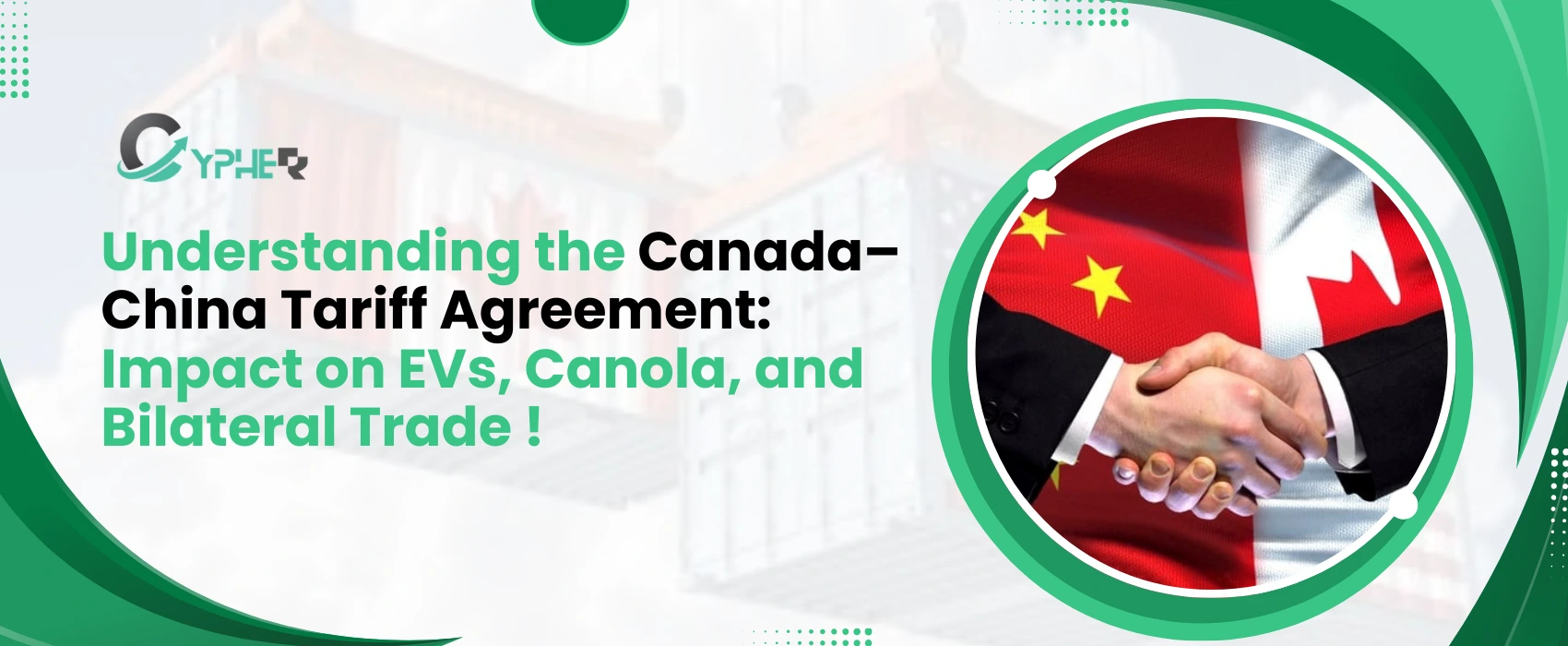
Understanding the Canada–China Tariff Agreement Impact on EVs, Canola, and Bilateral Trade
02 Mar 2026
Canada–China trade relations have entered a strategically sensitive and highly complex phase. After several years of strained ties characterized by tariffs, import barriers, and diplomatic friction, both countries are reassessing their economic partnership amid rapidly shifting global dynamics. Growing geopolitical fragmentation, supply chain realignment, and climate-driven industrial strategies—particularly in electric vehicles (EVs) and clean technology—have brought tariffs and market access back to the forefront of bilateral trade negotiations.
In early 2026, Canada and China announced a significant reset in their economic engagement. Canadian Prime Minister Mark Carney described the renewed framework as delivering “historic gains” by capitalizing on shared strengths in agriculture, energy, technology, and financial services. Carney’s visit to China—the first official trip by a Canadian prime minister since 2017—marked an important diplomatic step toward rebuilding commercial ties following years of tariff disputes and escalating trade tensions. This renewed engagement comes at a time when global trade alliances are shifting and economic blocs are becoming more fragmented.
Recent trade figures underscore the scale of the relationship. Based on the latest Canada export market research report and China import market research report, total bilateral trade reached $85.75 billion in 2024, with $65.40 billion recorded in the first three quarters of 2025 alone. China continues to rank among Canada’s largest trading partners, while Canada remains a key supplier of agricultural commodities, natural resources, and increasingly, essential inputs for clean energy and advanced manufacturing sectors.
At the same time, both governments are adopting a more strategic use of tariffs and regulatory controls to safeguard domestic industries and advance long-term economic priorities. This evolving policy environment reflects a broader shift toward economic security and industrial competitiveness. This article examines the changing Canada–China tariff landscape, with particular attention to three critical areas: electric vehicles (EVs), canola and agricultural trade, and the broader structural forces shaping the future of Canada–China trade relations.
How the EV–Canola Tariff Agreement Is Transforming Canada–China Trade Relations
At the center of this renewed engagement is a preliminary tariff arrangement targeting two previously contentious sectors—electric vehicles (EVs) and canola—with implications extending far beyond these industries. Canada has agreed to significantly reduce tariffs on Chinese-manufactured EVs, permitting up to 49,000 vehicles to enter the Canadian market at a most-favored-nation rate of 6.1 percent. This marks a dramatic shift from the steep 100 percent tariffs imposed in 2024 under the previous administration. In return, China has committed to lowering tariffs on Canadian canola seeds and related agricultural exports, including canola meal, lobsters, crabs, and peas. The policy adjustment is expected to restore market access and unlock billions of dollars in export opportunities for Canadian producers following extended trade disruptions.
Both governments are framing this development as a strategic step toward more stable and sustainable economic cooperation, even as broader geopolitical tensions remain unresolved. Canada—traditionally deeply connected to both the United States and China—appears increasingly focused on diversifying its trade partnerships and reducing overreliance on any single market. This approach reflects a pragmatic response to volatile tariff regimes and the ongoing fragmentation of the global trading system. For China, strengthening trade ties with a major Western economy offers stability at a time when global supply chains and political alliances are rapidly evolving.
While this agreement does not constitute a comprehensive free trade pact, it elevates tariff policy as a central instrument in rebuilding bilateral economic ties. By concentrating on sectors that align closely with each country’s industrial priorities—EV manufacturing for Canada’s clean energy transition and canola agriculture to support China’s food security and industrial demand—the deal signals a calculated recalibration of Canada–China trade relations.
In the following sections, we examine the shifting tariff framework in greater detail, assess its impact on Canada’s EV and agricultural sectors, and explore the broader trade implications as both nations navigate an increasingly complex global economy.
Analyzing Canada–China Trade: Scale, Sectoral Composition, and Deficit Trends
Canada–China trade remains substantial in scale but structurally imbalanced. By the mid-2020s, annual two-way merchandise trade exceeded CAD 100 billion (approximately USD 80 billion), underscoring the depth of economic ties between the two countries. However, the relationship is marked by a persistent trade deficit on Canada’s side, as it imports significantly more from China than it exports. Chinese shipments to Canada are largely composed of manufactured goods, while Canadian exports to China are concentrated in primary commodities. China ranks as Canada’s second-largest trading partner after the United States, yet Canada represents a mid-tier partner for China, highlighting an asymmetrical level of dependence within the bilateral relationship.
Canada’s imports from China are heavily concentrated in consumer electronics, machinery and electrical equipment, furniture and household goods, textiles and apparel, as well as batteries and battery components. These products are competitively priced and deeply integrated into Canadian retail networks and industrial supply chains, making them difficult to substitute in the short term. In contrast, Canada’s exports to China are narrower in scope and often subject to greater volatility. They are dominated by canola and related products, wheat and barley, pork and seafood, wood pulp and lumber, and various minerals and energy-related inputs. This structural imbalance means that tariffs and non-tariff trade barriers tend to have a disproportionately strong impact on Canadian exporters, particularly in the agricultural and resource sectors.
Canada–China Trade (Last 10 Years): Annual Import–Export Performance
Over the past decade, bilateral trade between Canada and China has shown steady growth overall, despite periodic volatility driven by global and diplomatic factors. In 2015, total trade stood at $67.26 billion, before dipping slightly to $64.44 billion in 2016. Trade rebounded in 2017 to $72.88 billion and continued climbing in 2018, reaching $79.71 billion. However, 2019 saw a decline to $74.07 billion amid rising trade tensions and geopolitical uncertainty.
Despite the global disruption caused by the COVID-19 pandemic, total trade increased to $76.04 billion in 2020, reflecting resilient commodity flows and strong Chinese demand for Canadian resources. The recovery accelerated in 2021, with trade surging to $91.01 billion, followed by a peak of $99.11 billion in 2022 — the highest level in the past ten years. In 2023, trade moderated to $88.72 billion and declined slightly further to $85.75 billion in 2024, indicating a cooling phase amid tariff disputes and shifting supply chain strategies. For 2025, trade reached $65.40 billion in the first three quarters alone, suggesting that full-year figures could remain substantial depending on fourth-quarter performance. Overall, the market research report reflects a relationship characterized by long-term expansion, short-term fluctuations, and strong underlying economic interdependence.
How Tariffs Shape Canada–China Trade Relations
Unlike comprehensive free trade agreements, tariff arrangements between Canada and China tend to be selective, reactive, and politically sensitive. Rather than broad-based liberalization, trade measures are often targeted at specific sectors and are frequently accompanied—or substituted—by regulatory barriers, licensing requirements, and administrative controls. In recent years, China imposed tariffs on approximately $2.6 billion worth of Canadian agricultural and food products, including canola oil and canola meal, in response to earlier tariff measures introduced under the government of Justin Trudeau. In August, Beijing extended restrictions by placing tariffs on Canadian canola seed, contributing to a reported 10.4 percent decline in China’s imports of Canadian commodities in 2025.
Under the newly negotiated framework led by Prime Minister Mark Carney, Canada expects China to significantly reduce its canola seed tariffs—from 84 percent to a combined rate of roughly 15 percent—by March 1. Ottawa also anticipates the removal of anti-discrimination duties on canola meal, lobsters, crabs, and peas beginning March 1 and lasting at least through the end of the year. These developments reflect the highly strategic nature of the bilateral tariff environment, which is characterized by limited tariff liberalization, extensive reliance on non-tariff measures, sector-specific restrictions rather than economy-wide agreements, and a strong linkage between trade actions and broader political dynamics. This broader policy context is essential for understanding developments in the EV and canola sectors, where trade measures intersect directly with industrial strategy, food security, and national economic priorities.
EV Trade Dynamics: Tariffs, Government Incentives, and Global Competition
China has established itself as the world’s largest producer and exporter of electric vehicles (EVs) and related components, giving it a dominant position across the global EV supply chain. The country controls substantial shares of battery cell manufacturing, rare earth mineral processing, cathode and anode material production, and EV platform manufacturing. This vertically integrated ecosystem, supported by strong industrial policy and economies of scale, has enabled Chinese EV exports to expand rapidly across international markets. As a result, many importing countries have raised concerns about potential market distortions linked to state subsidies, cost advantages, and supply chain concentration.
Meanwhile, Canada is actively developing its own EV and battery manufacturing ecosystem as part of a broader clean energy and industrial strategy. The country has positioned itself as a North American hub for sustainable automotive production, backed by large-scale investment incentives, the development of domestic battery plants, and expanded critical mineral extraction and processing. Canada’s approach is closely aligned with its North American partners, emphasizing supply chain resilience, clean technology leadership, and reduced dependency on concentrated foreign suppliers. Protecting this emerging EV ecosystem has therefore become a central objective of Canadian trade and tariff policy, particularly in the context of growing strategic competition in the global electric vehicle market.
Electric Vehicle Tariffs in Canada–China Trade Relations
Canada does not maintain a comprehensive free trade framework with China specifically covering electric vehicles (EVs). Instead, bilateral EV trade is governed by existing Most-Favored-Nation tariff rates, heightened scrutiny of state subsidies, and alignment with broader industrial and national security priorities. Canadian authorities have signaled their readiness to deploy trade defense mechanisms such as anti-dumping investigations, countervailing duties, and stricter foreign investment screening where necessary. Even when formal tariff rates remain unchanged, these instruments can function as effective trade barriers, shaping competitive conditions for Chinese EV imports in the Canadian market.
At present, Chinese EVs account for only a small share of Canada’s overall automotive market. However, policymakers view the issue through a forward-looking lens. Chinese manufacturers benefit from lower production costs, rapid technological advancement, and highly competitive export pricing, creating the potential for significant long-term market disruption. As a result, Canada’s tariff and regulatory posture is largely preemptive—designed to influence future market structure and protect its emerging domestic EV and battery ecosystem rather than simply responding to current import volumes.
On the other side of the supply chain, China exports finished EVs but remains reliant on imported upstream inputs, an area where Canada holds strategic advantages. Canadian exports relevant to EV supply chains include nickel, cobalt, copper, lithium-related materials, and potash used in battery-related chemical processing. China has generally kept tariff barriers on these critical inputs relatively low to ensure stable supply. However, market access is increasingly shaped less by tariffs and more by strategic control mechanisms such as licensing systems, long-term supply agreements, and state-linked procurement practices. These tools play a decisive role in determining the scale and stability of Canada’s export opportunities within China’s EV supply chain.
Why Canola Remains the Most Sensitive Issue in Canada–China Trade
Canada is one of the world’s leading producers and exporters of canola, making the crop a cornerstone of its agricultural economy. Annual production exceeds 20 million tons, and China has historically accounted for roughly 30–40 percent of Canada’s total canola exports. The industry supports tens of thousands of farmers, grain handlers, processors, and related supply chain workers across the country. Because of this heavy reliance on the Chinese market, few Canadian export sectors are as exposed to China-specific trade policy risks as canola.
China’s trade actions affecting Canadian canola have often gone beyond straightforward tariff adjustments. Rather than relying solely on headline tariff increases, Chinese authorities have employed measures such as import suspensions, stricter quality inspections, revocation of exporter licenses, and administrative delays at ports. Even when nominal tariff rates remain unchanged, these regulatory and procedural barriers can significantly restrict market access, effectively functioning as powerful non-tariff trade barriers.
The economic consequences of such restrictions have been substantial. During periods of limited access to the Chinese market, domestic canola prices in Canada have faced downward pressure, while exporters have been forced to redirect shipments to alternative markets, often at lower profit margins. In addition, fluctuations in export demand have led to inconsistent utilization rates at processing facilities, affecting operational efficiency and revenue stability. These outcomes illustrate how non-tariff barriers can, in practice, be more disruptive than formal tariffs, particularly in sectors with high market concentration and limited immediate substitutes.
Tariff Agreements and Managed Trade in Agricultural Markets
Canola is treated differently within the agricultural trade relationship between Canada and China because it intersects directly with food security, domestic price stability, and political considerations. China’s approach to agricultural imports is influenced not only by market demand but also by strategic priorities, including safeguarding domestic producers, stabilizing consumer prices, and maintaining policy flexibility during diplomatic tensions. Consumer safety narratives and regulatory scrutiny further shape import decisions. As a result, China often favors managed trade mechanisms—such as licensing systems, inspection protocols, and administrative controls—over straightforward, transparent tariff reductions. Even when official tariff rates are relatively low, market access can remain conditional, unpredictable, and closely tied to the broader state of bilateral relations.
In response to recurring volatility in canola trade, Canada has adopted a strategy focused on diversification and value addition. This includes expanding domestic crushing capacity to process more raw seed into higher-value products, broadening export destinations across Asia and Europe, and promoting value-added exports such as canola oil and meal rather than relying solely on raw seed shipments. While China continues to be a major market, its relative share of Canadian canola exports has declined compared to a decade ago. This shift reduces Canada’s vulnerability to sudden trade disruptions, though it does not fully eliminate the sector’s exposure to policy shifts in the Chinese market.
Beyond EVs and Canola: Additional Tariff-Sensitive Sectors in Canada–China Trade
Beyond EVs and canola, several other Canadian export sectors remain highly sensitive within the trade relationship between Canada and China. Meat exports, particularly pork and beef, are especially vulnerable to regulatory and administrative controls. While applied tariff rates on these products are generally low, market access can be rapidly restricted due to health certification requirements, disease outbreak concerns, or changes in inspection regimes. Even temporary suspensions linked to sanitary or phytosanitary standards can significantly disrupt trade flows, making administrative measures more consequential than tariffs themselves.
Seafood exports face a similar dynamic. Trade volumes are influenced by seasonal demand patterns, evolving consumer preferences within China, and inspection-related delays at ports of entry. In this sector, regulatory approvals and compliance procedures often play a larger role in determining access than formal tariff rates. Meanwhile, Canadian wood products and pulp exports are closely tied to conditions in China’s construction and real estate sectors. Although tariff levels on these goods remain moderate, cyclical demand fluctuations—driven by infrastructure spending and housing activity—tend to have a greater impact on trade volumes than trade policy alone. Together, these sectors illustrate how non-tariff factors and macroeconomic trends frequently outweigh headline tariff rates in shaping bilateral trade outcomes.
The Growing Importance of Tariffs in a Shifting Global Trade Order
Trade between Canada and China reflects a wider transformation underway in the global trading system. Traditional tariff barriers are no longer the sole—or even primary—tools shaping cross-border commerce. Instead, strategic controls, industrial policy, supply chain security measures, and regulatory oversight increasingly determine market access and competitive positioning. Modern trade arrangements are becoming more selective and sector-specific, focusing on strategically important industries rather than pursuing broad, economy-wide liberalization.
Within this context, electric vehicles (EVs) symbolize the future of industrial competition, driven by state-backed investment, technology development, and supply chain integration. In contrast, canola represents a more traditional commodity-based trade relationship, rooted in agricultural exports and long-established demand patterns. Yet both sectors demonstrate how trade outcomes are now shaped as much by government policy, strategic priorities, and geopolitical considerations as by pure market forces.
Business Strategy in a Shifting Canada–China Trade Environment
For businesses operating within the trade corridor between Canada and China, proactive risk management has become essential rather than optional. Companies must prepare for policy-driven disruptions, abrupt changes in market access, and a trade environment defined more by structural uncertainty than short-term volatility. Shifts in tariffs, licensing requirements, inspections, or geopolitical developments can quickly alter commercial conditions, making scenario planning and regulatory monitoring critical components of corporate strategy.
Sector-specific approaches are equally important. Firms involved in EV-related supply chains should emphasize upstream integration, secure access to critical minerals, and position themselves within trusted and transparent supply networks. Agricultural exporters, particularly those exposed to concentrated markets, should continue diversifying export destinations while expanding value-added processing capacity to reduce vulnerability to raw commodity shocks. Meanwhile, resource exporters would benefit from prioritizing long-term supply agreements and stable partnerships over reliance on spot market sales, thereby improving revenue predictability in an increasingly managed trade environment.
Future Prospects for Canada–China Economic Engagement
In the evolving trade relationship between Canada and China, certain outcomes appear unlikely in the near term. A comprehensive free trade agreement covering all sectors remains improbable, as does broad-based tariff elimination across the board. Similarly, fully depoliticized trade relations are unrealistic given the strategic, security, and geopolitical dimensions that now shape economic engagement between the two countries.
More plausibly, the bilateral relationship will continue to rely on selective tariff measures targeted at specific industries rather than sweeping liberalization. Non-tariff instruments—such as licensing controls, inspections, administrative procedures, and regulatory oversight—are expected to play an even greater role in shaping market access. Sensitive sectors, particularly electric vehicles, batteries, clean technology, and key agricultural commodities, will likely remain subject to strategic trade management and heightened scrutiny. Overall, trade volumes between Canada and China are expected to remain significant, but access will increasingly be conditional, policy-driven, and closely linked to broader diplomatic and industrial priorities.
Major Highlights of the Canada–China Trade and Strategic Partnership Agreement
Canada and China have agreed to establish a new strategic partnership designed to generate what leaders describe as “historic gains” by leveraging complementary strengths in agriculture, energy, agri-food, and finance. The agreement followed the first official visit to China by a Canadian prime minister since 2017, signaling a diplomatic reset after years of strained relations and tariff-related disputes. Central to the announcement is a preliminary trade arrangement featuring targeted tariff reductions on high-impact sectors. Canada will permit up to 49,000 Chinese electric vehicles (EVs) to enter its market at a 6.1 percent tariff rate, a sharp reduction from the previous 100 percent duties. In return, China is expected to lower tariffs on Canadian canola seed from 84 percent to approximately 15 percent by March 1, 2026. Additional agricultural exports—including canola meal, lobsters, crabs, and peas—are anticipated to be exempt from discriminatory tariffs at least through the end of the year.
These adjustments are projected to unlock nearly $3 billion in Canadian export orders, offering significant benefits to farmers, fish harvesters, and food processors. China continues to rank as Canada’s second-largest export market, and the tariff revisions aim to revitalize trade flows that had been constrained by earlier policy disputes. Beyond tariff measures, the partnership includes commitments to resume high-level economic and financial dialogues, strengthen two-way trade and investment, and deepen cooperation in green energy, oil, gas, and clean technology sectors. Discussions also extend to potential visa-free travel arrangements for Canadians visiting China, enhanced energy grid collaboration, and expanded liquefied natural gas (LNG) exports to Asian markets. The agreement unfolds within a broader geopolitical context, as Canada seeks to diversify its trade portfolio and reduce heavy dependence on the U.S. market amid shifting global tariff dynamics.
Final Verdict: The Future of Canada–China Trade Relations
In conclusion, the trade relationship between Canada and China is shaped less by sweeping free trade agreements and more by careful strategic calibration. Electric vehicles symbolize the future of industrial competition, where tariffs and trade defenses act as protective tools for emerging domestic ecosystems. In contrast, canola reflects a legacy commodity dependence, where market access is influenced as much by political dynamics and regulatory controls as by formal tariff schedules. For policymakers, businesses, and investors, understanding this evolving balance is essential. Canada–China trade is no longer solely about expanding volumes; it is increasingly about managing risk, safeguarding strategic industries, and adapting to a fragmented global trading environment.
In this context, tariffs represent only one dimension of a broader policy framework. The deeper narrative lies in the intersection of trade policy, industrial strategy, and geopolitics—factors that ultimately determine who trades, what products move across borders, and under which conditions.
We hope you found this comprehensive and insightful analysis of the latest Canada–China trade agreement and bilateral trade trends valuable. For deeper insights into global trade market research report or to explore live import–export market research report by country, visit Cypher Exim. For customized trade reports and tailored market intelligence, reach out to us at sales@cypherexim.com.